SEO vs GEO: what changes when AI answers the search
SEO vs GEO for UK businesses: what stays the same, what changes when AI answers the search, and one plan that covers Google and the AI assistants.
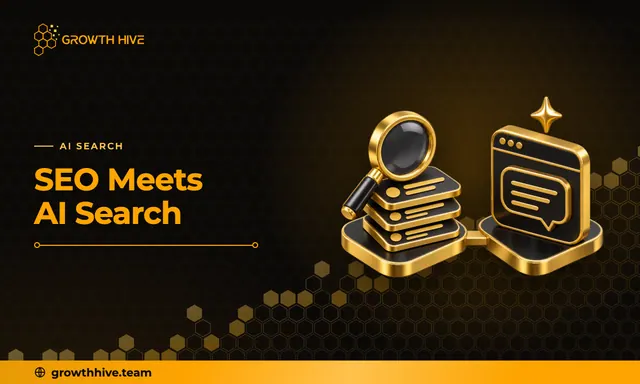
SEO gets your pages found in search results. GEO, short for generative engine optimisation, is the work of getting those same pages used and cited when ChatGPT, Gemini or Google’s AI Overviews answer the question instead. For most UK businesses they are one job: the foundations are identical, and what changes is how you write, what you measure and how closely you watch the facts AI tools repeat about you.
SEO, GEO and AEO in plain words
SEO (search engine optimisation) is everything that helps your pages appear, and get clicked, in search results: a site search engines can crawl, pages that match what people search for, and a reputation other sites vouch for.
GEO (generative engine optimisation) covers the same ground, aimed at AI-written answers. The goal is for an assistant to name your business, quote your page or link to it as a source.
AEO (answer engine optimisation) is the older term. It began with featured snippets and voice assistants, and now means much the same as GEO.
| Classic SEO | GEO / AEO | |
|---|---|---|
| Where you appear | The list of results, the map pack | Inside an AI answer, as a mention or a cited link |
| What success looks like | A ranking and a click | Being named or cited, sometimes with no click |
| What it is built on | Crawlable, useful, trusted pages | The same pages, plus consistent facts across the web |
| How you measure it | Search Console, analytics, enquiries | Search Console’s AI report, AI referrals, prompt checks, enquiries |
Google has said it does not treat these as separate disciplines. Its guide to optimising for generative AI features, published in May 2026, calls optimising for AI search “optimizing for the search experience”, in other words SEO. That is how our SEO and AI search service is built too: one plan, measured on both.
What stays the same: crawlable pages, useful answers, a trusted brand
Google’s page on AI features and your website is blunt: “There are no additional requirements to appear in AI Overviews or AI Mode, nor other special optimizations necessary.” To be shown as a supporting link, a page must be indexed and eligible to appear in Google Search with a snippet. If a page cannot rank, it cannot be cited either.
The reason is how the answers are built. Google says its AI features use grounding, which retrieves pages from its Search index using its core ranking systems, and “query fan-out”, which runs several related searches on subtopics at once. A question about boiler servicing might fan out into searches about costs, frequency and landlord rules. Your page needs to be the best answer to at least one of those.
So the basics still decide most of the outcome:
- Pages that search engines can crawl and index, linked from the rest of your site.
- Content that answers the question better than the pages around it.
- A brand that other sites, reviewers and directories mention in consistent terms.
What changes: answer-first writing, being cited, consistent facts
Three things deserve more attention than they did a few years ago.
Answer-first writing. Put the direct answer in the first two or three sentences, then the detail. Google says you do not need to write in a special way for AI or break pages into tiny chunks, and that is right: answer-first is simply good writing for people in a hurry. It also happens to give an AI system a clean sentence to quote.
Being cited, not just ranked. In an AI answer, the prize is a mention or a source link. Your page has to say something specific enough to be worth citing: your prices, your process, your local knowledge. Google’s guide warns against “commodity” content that repeats what everyone else has written.
Consistent facts. AI assistants assemble their picture of your business from your website, your Google Business Profile, directories and reviews. If your opening hours, address or services differ between them, the answer may repeat the wrong version. Google’s guide notes that an up-to-date Business Profile can help you appear in AI responses as well as in normal results.
Is SEO dead? What the evidence says
No, but the reward for it has shifted.
The evidence for “dead” is that fewer searches end in a click. A Pew Research Center study of 900 US adults’ browsing in March 2025 found people clicked a traditional result in 8% of visits to a results page with an AI summary, against 15% when there was none. Links inside the summary itself were clicked in 1% of those visits. That is US data from one month, but the direction is clear.
The evidence against “dead” is where the answers come from. Google says its AI features are built on its Search index and ranking systems, so the pages that do well in normal search are the ones the AI draws on. Google also reports that clicks from results pages with AI Overviews tend to be higher quality, with people spending more time on the site. That is Google’s own claim, so test it against your analytics.
AI answers are also no longer a side feature. In a 2026 post for website owners, Google said AI Overviews had over 2.5 billion monthly users and AI Mode more than one billion. A business that ignores them is ignoring how a large share of its customers now search.
How AI search picks its sources, as far as the platforms have said
None of the platforms publishes a ranking formula, and anyone who claims to know one is guessing. Here is what they have stated:
- Google AI Overviews and AI Mode draw from the Search index through grounding and query fan-out. Since 31 August 2026 every site can use a Search Console setting to opt out of these features, but Google says sites that opt out “will not receive traffic or impressions” from them.
- ChatGPT finds pages for its search answers with a crawler called OAI-SearchBot. OpenAI’s crawler documentation says sites that block it will not be shown in ChatGPT search answers. OpenAI also says ChatGPT search sometimes sends queries to partner search providers, and its help centre lists Microsoft among them.
- Claude uses Claude-SearchBot to index pages for search. Anthropic says blocking it may reduce your visibility in Claude’s answers.
The practical detail, from robots.txt rules to the difference between search crawlers and training crawlers, is in our guide on how to get cited by ChatGPT and AI Overviews.
One plan for both: what a small business should do this quarter
You do not need a separate GEO budget. Work through this list over the next three months:
- Check indexing. In Google Search Console and Bing Webmaster Tools, confirm your important pages are indexed and fix any that are not.
- Check who is blocked. Open your robots.txt file and your CDN or hosting firewall settings. Make sure Googlebot, Bingbot and the AI search crawlers can reach your pages. Decide about training crawlers separately.
- Rewrite your top five service pages answer-first. Open each with who you help, where, roughly what it costs and how long it takes.
- Line up your business facts. Name, address, phone, hours and services should match on your site, your Business Profile and the main directories.
- Publish one piece of original content a month. A dental practice in Leeds, for example, could explain exactly what a first appointment includes and what it costs, with photos of the real surgery. That is content an AI cannot copy from elsewhere.
- Keep collecting genuine reviews, and reply to them.
If you are still at the start, our guide to SEO costs and priorities for UK small businesses sets out the order of work in more detail.
Measuring visibility in AI answers
You cannot measure AI visibility as precisely as rankings yet, but there are now real numbers to look at.
- Search Console. Google’s Search generative AI performance reports, available to all sites since 31 August 2026, show impressions of your pages in AI Overviews, AI Mode and Discover’s AI features, by page, country, device and date. Clicks from AI features are counted in the main Performance report under the Web search type.
- Bing Webmaster Tools. Its AI Performance report, in public preview since February 2026, shows how often your pages are cited in Microsoft Copilot and Bing’s AI summaries. Bing says the data is a sample.
- Analytics. OpenAI says ChatGPT adds
utm_source=chatgpt.comto links it sends, so ChatGPT visits show up as their own source in GA4. Set up a channel or report for AI assistants. - A monthly prompt log. Write down 10 to 20 questions your customers ask and put them to ChatGPT, Gemini and Copilot each month. Record whether you are named, what is said and which sources are cited. Answers vary from run to run, so look for trends rather than single results.
- Enquiries. Add “AI assistant” as an option when you ask new customers how they found you.
Next step
SEO and GEO are one plan with a few extra checks, not two projects. If you want to know where your site stands, our SEO and AI search team will look at your pages, your competitors and how AI assistants currently describe your business, then tell you what we would fix first. We do not promise that any AI tool will mention you; we show you what changes and measure it.
Frequently asked questions
Is SEO dead?
No. Google says its AI features in Search are rooted in its core ranking and quality systems, and a page must be indexed and eligible to show with a snippet before it can appear as a link in an AI Overview. What has changed is that some searches now end without a click, so you measure visibility and enquiries, not rankings alone.
What is generative engine optimisation?
Generative engine optimisation (GEO) is the work of making your pages easy for AI tools such as ChatGPT, Gemini and Google's AI Overviews to understand, trust and cite. In practice it is mostly good SEO: crawlable pages, clear answers, original content and consistent facts about your business. Google's own guide describes optimising for its AI features as SEO.
What is answer engine optimisation (AEO)?
AEO is an older name for writing pages that answer questions directly, first for featured snippets and voice assistants and now for AI answers. It overlaps almost entirely with GEO. Treat both as parts of one search plan rather than separate services with separate budgets.
Do I need GEO as well as SEO?
You need one plan that covers both, not two. The extra work for AI search is small: let AI search crawlers in, write answer-first pages, keep your business facts consistent and check how AI tools describe you. Be wary of anyone selling tactics Google says it does not use, such as llms.txt files or splitting pages into chunks.